

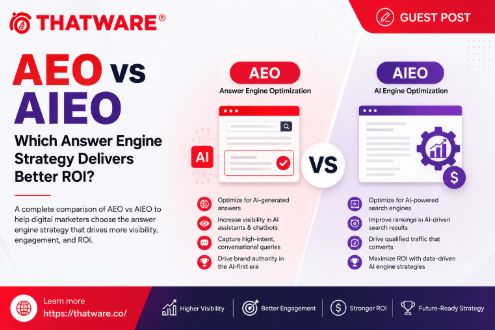
ROI conversations in digital marketing have always been messy. Attribution is hard, timelines are long, and the goalposts keep moving. But there’s one question that’s becoming increasingly urgent in 2026: if you’re going to invest in AI-era search optimization, which strategy actually delivers returns — AEO, AIEO, or some combination of both?
To answer that, you first need to understand what each strategy actually does. And then you need to be honest about what you’re trying to achieve.
Let’s start there.
AEO: The Original Answer-Focused Strategy
Answer Engine Optimization predates the current AI search boom. It emerged primarily around voice search and featured snippet optimization — the idea that search engines were evolving toward delivering direct answers rather than lists of links, and that brands needed to optimize for that format.
AEO tactics are fairly well-established: structure content around question-and-answer formats, use FAQ schema markup, write concise and direct answers to common queries, optimize for featured snippets and People Also Ask sections. The target was essentially Google’s answer surfaces — Knowledge Panels, featured snippets, voice search results.
This work is still valuable. Google still serves featured snippets. Voice search still happens. Structured, answer-formatted content still performs well. AEO hasn’t become irrelevant — but its scope has become limited relative to the current landscape.
Where AEO Falls Short in 2026
The problem with AEO in 2026 isn’t that it’s wrong. It’s that it was designed for a search environment that has partially been superseded.
AEO assumes the primary answer surface is Google. It optimizes for how Google’s algorithms identify and present direct answers. That’s still relevant, but Google is no longer the only — or in some demographics, even the primary — place people go for answers.
When someone asks ChatGPT a question, the mechanics of how an answer is generated and sourced are fundamentally different from how Google selects a featured snippet. The signals are different. The structure of the content that gets referenced is different. The role of brand entity recognition is different.
AEO tactics, applied without adaptation to AI assistant environments, simply don’t translate fully. You can have perfectly formatted FAQ schema on every page and still be invisible in AI-generated responses, because your brand isn’t recognized as a trusted entity, because your content lacks the semantic depth LLMs evaluate, because the behavioral signals that retrieval-augmented AI systems consider aren’t there.
AIEO: Built for the Current Moment
AEO vs AIEO agency discussions often focus on tactics, but the more important difference is philosophy. AEO is a tactical set built for a specific search surface. AIEO is a strategic framework built for AI-mediated information environments broadly — which includes but extends well beyond any single platform.
AIEO asks: how do we optimize our brand’s entire digital presence so that AI systems — of all types, across all platforms — recognize us, trust us, and reference us when relevant topics arise? It addresses entity recognition, semantic content architecture, behavioral signals, multi-surface presence, and the technical layer that makes all of it accessible to AI systems.
The ROI case for AIEO is built on durability and breadth. A successful AIEO strategy doesn’t just get you cited by one AI platform in response to one type of query. It establishes your brand as a recognized authority that AI systems across the ecosystem associate with your domain of expertise.
The ROI Question: Breaking It Down
Now to the actual money question. Which delivers better ROI?
The honest answer: it depends on your starting point, your competitive context, and your time horizon.
Short-term ROI: AEO has the edge. The tactics are established, the implementation is faster, and the results (featured snippet appearances, structured answer placements, voice search captures) are measurable with existing tools. If you need to show wins quickly, AEO tactics deliver them faster.
Medium-term ROI: It starts to flip. As AI search adoption grows, AIEO for AI answer engines delivers increasingly meaningful results. Brands that have established entity recognition and semantic authority in AI systems start to see consistent citation in AI-generated responses — visibility that compounds as more users adopt AI assistants.
Long-term ROI: AIEO wins substantially. The brand infrastructure built through a comprehensive AIEO strategy — entity authority, semantic depth, multi-surface presence — doesn’t depreciate the way tactical optimizations do. It accumulates and compounds. An AEO-optimized FAQ page might lose its featured snippet when Google updates its algorithms. A well-established brand entity in AI knowledge systems is much more durable.
The Compounding Effect of AIEO
Here’s something that doesn’t get discussed enough in ROI conversations: AIEO’s returns compound in a way that most digital marketing investments don’t.
When your brand is established as a recognized entity with strong semantic authority, AI systems don’t just cite you for queries you’ve specifically optimized for. They begin to associate you with broader topic clusters — mentioning your brand in adjacent conversations, recommending your content in tangentially related discussions, referencing your expertise in contexts you didn’t explicitly target.
This is the brand awareness equivalent of earned media, but in AI environments. It’s hard to measure directly, but the long-term value is substantial and very difficult for competitors to replicate quickly.
AEO doesn’t create this kind of compounding effect. It’s transactional — optimize for a query, capture a placement, measure the result. Valuable, but not compounding.
Practical Recommendations
For most businesses, the right answer isn’t a choice between AEO and AIEO — it’s a sequenced strategy that incorporates both.
Start with AEO if you haven’t already. Structured content, FAQ schema, direct answer formatting — these are table stakes for any serious digital marketing program in 2026. They’re not expensive, they’re not complicated, and they deliver measurable short-term value.
Build AIEO on top. Entity establishment, semantic content deepening, behavioral signal development, multi-platform presence — layer these onto the AEO foundation over a 6-12 month horizon. Track AI mention frequency, citation rates across major LLM platforms, and share-of-voice in AI-generated responses.
The brands that will have the strongest AI visibility position in 2027 are the ones that are doing both right now — not the ones that chose sides.
A Note on Measurement
One practical challenge with AIEO ROI is measurement. Traditional digital marketing ROI calculations rely on clean attribution data — clicks, conversions, revenue. AI-influenced visibility is harder to attribute directly, especially when users never click through to your site.
The emerging measurement stack for AIEO includes AI mention monitoring tools, share-of-AI-voice tracking, brand search volume trends (a proxy for AI-driven awareness), and direct traffic trends. It’s not as clean as Google Analytics, but the field is developing fast.
Don’t let measurement complexity discourage investment. The brands that waited for perfect attribution models before investing in social media or content marketing missed significant windows. The same risk applies here.
Final Verdict
AEO remains a valuable, practical component of a modern search strategy. It’s not going away, and ignoring it would be a mistake.
But AIEO is the higher-leverage play for brands thinking beyond the next quarter. The investment is greater, the timeline is longer, and the measurement is harder — but the returns are broader, more durable, and increasingly difficult for late movers to replicate. Explore what a full AIEO strategy looks like for your brand and decide for yourself. The window for early-mover advantage is open, but it won’t stay that way forever.